

SUBSCRIBER CONTENT
Sandals Resorts International (SRI) intends to build 18 overwater villas at its Dunn’s River property on Mammee Bay Beach near the resort town of Ocho Rios in St. Ann.
The all-inclusive property already restricts beach access to the public. Now, there are concerns that this proposed development could limit access to the state-owned sea.
But before any decision is taken as to whether Sandals should be granted the required license to build villas over the sea, there’s a more fundamental question the Natural Resources Conservation Authority (NRCA) needs to answer since it serves as the country’s Beach Control Authority with Prime Minister Dr. Andrew Holness as the responsible minister:-
On what basis is Sandals Dunn’s River currently being allowed to exclude Jamaicans from the beach?
When I called Sandals Dunn’s River on August 24 and asked whether we, as members of the public, have access to that beach, a hotel representative told me, “No, you don’t.”
I enquired about daypasses that usually include food and drinks but also allow you to use the beach, and the rep mentioned that, ordinarily, those would cost US$300, but, “We’re currently not doing that right now.”
Yet, the NRCA’s administrative arm, National Environment and Planning Agency (NEPA), has confirmed to me in writing that Sandals Dunn’s River doesn’t have an exclusive beach license that allows the property owner or licensee to deny access to other users of the beach and sea in their licensed area, according to the country’s draft Beach Policy of 2000, which continued to inform NEPA’s planning guidance even in 2017.
According to the same policy, new exclusive beach licenses stopped being issued in 1976 after they were being used by hotels and other property owners to prohibit public access to beaches. The exclusive licenses that did exist —except in industrial areas —were to be phased out over two years.
The Sandals Dunn’s River Beach License
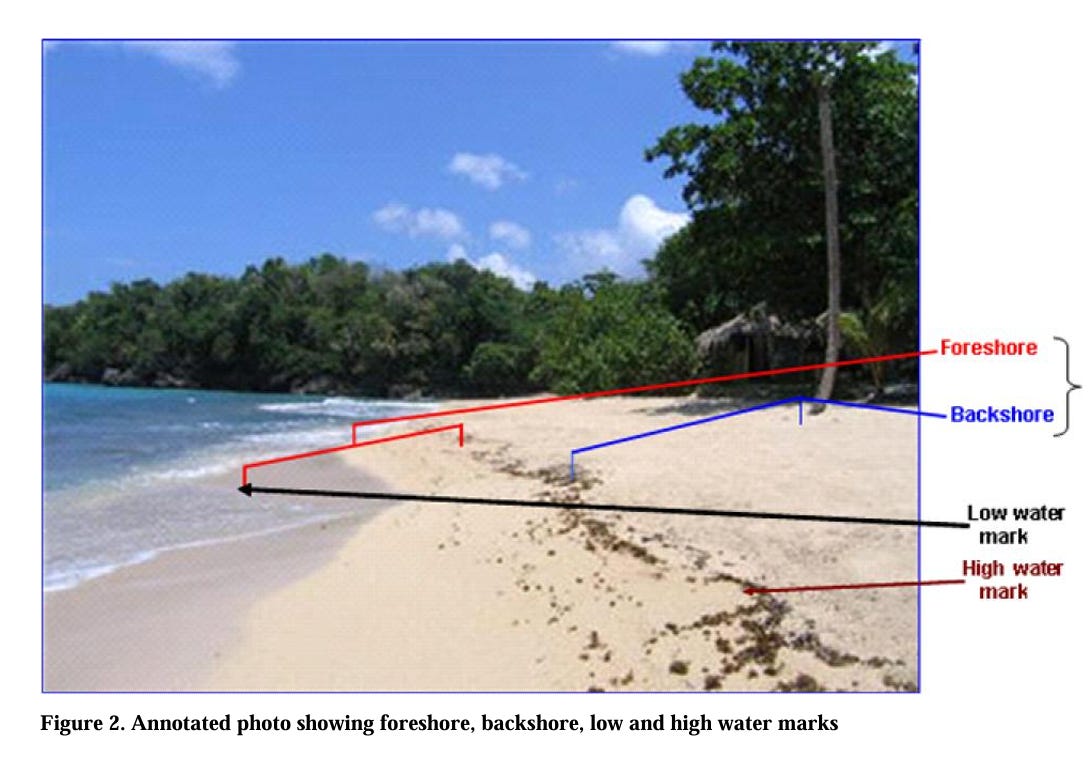
The NRCA beach license for Sandals Dunn’s River, obtained under the Access to Information Act (ATI Act), is in the name of the registered property owner, Riverland Holdings Limited, and is for commercial and recreational use of 200 meters of foreshore and the floor of the sea. The foreshore is the wet sand area between the high- and low-water marks where the sea ebbs and flows.
The resort’s beach license states that the licensee “shall not deny any person admission to or eject any person from the area prescribed in this Licence provided such person is properly attired and behaves in an orderly manner and is not a nuisance to other patrons.”
And it goes even further.
The licensee is also supposed to adhere to the Beach Control (Hotel, Commercial and Public Recreational Beaches) Regulations, 1978 — an actual law — that requires a licensee to exhibit prominently on or near the beach “the hours during which the beach is open to the public” — which two different hotel representatives separately confirmed to me on September 19 and October 30 that no such sign is displayed.