Four years ago, I submitted an Access to Information request to the National Environment and Planning Agency (NEPA), the development and environmental regulatory agency overseen by Prime Minister Dr. Andrew Holness.
I had requested copies of all applications made to NEPA by Imperium Investments Holdings Limited and Estatebridge Development Limited—two companies then connected to the prime minister.
The request was never fulfilled in 2022.
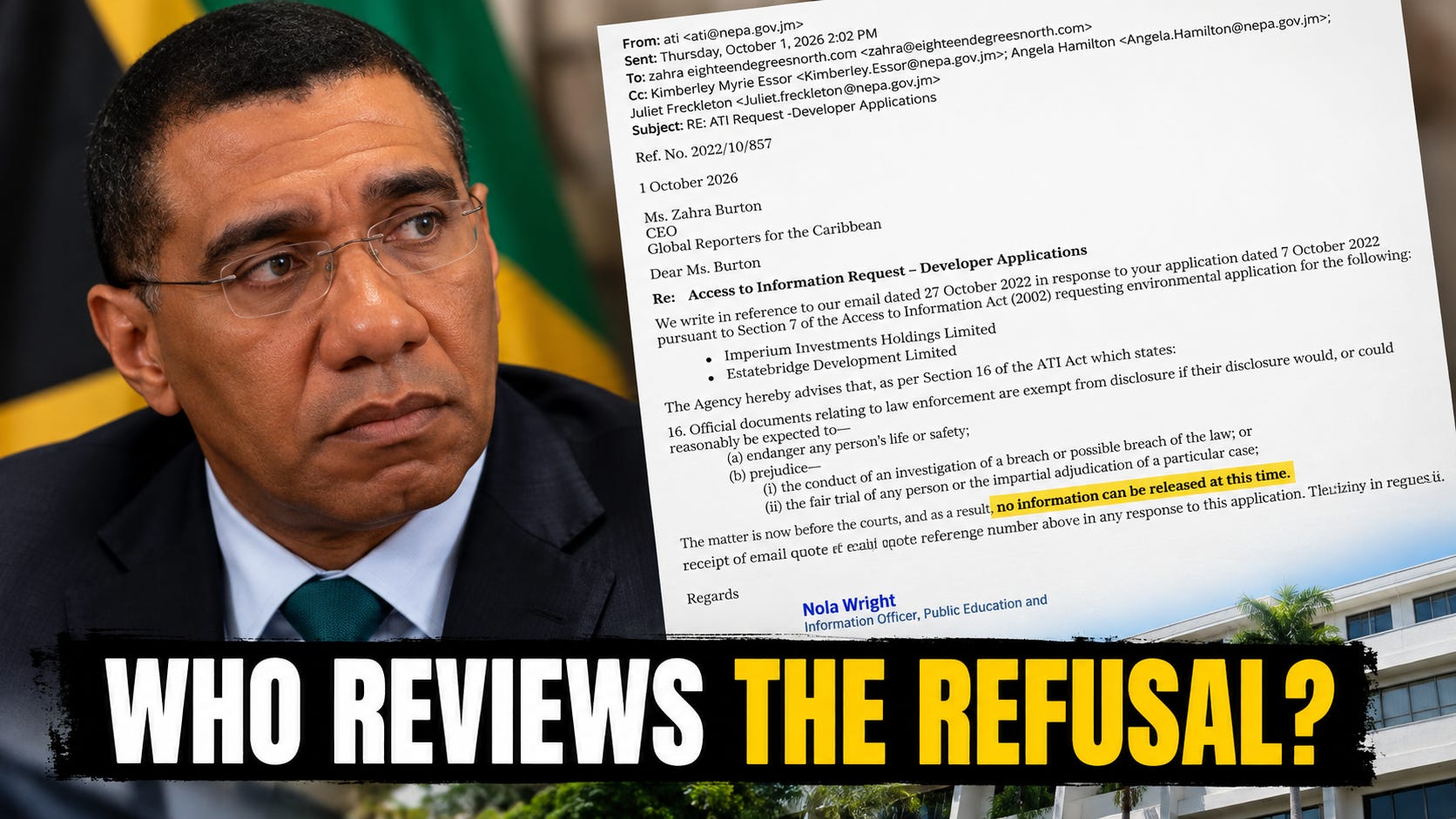
Then earlier this month, on Oct. 1, 2026, I finally got a response denying my request on the basis that the documents are exempt.
NEPA invoked Section 16 of the ATI Act, which deals with matters of law enforcement, and I now want to protest the decision.
However, the person designated in law to do the review appears to be Prime Minister Holness in his role as Minister of Economic Growth and Infrastructure Development (MEGID) presiding over NEPA.
How can PM Holness be expected to be an impartial reviewer when he has a personal interest in the documents?
This paradox exposes one of the many reasons why the ATI Act needs reform.
Four Years To Get To “No”
I submitted my request to NEPA on Oct. 7, 2022.
The agency wrote a few weeks later on Oct. 27, saying it would undertake the necessary research in order to satisfy the request “within the prescribed thirty (30) days.”
That didn’t happen.
Two years later, in 2024, both Imperium and Estatebridge were mentioned in an Integrity Commission investigation into the prime minister’s finances that found an unexplained increase in Holness’ net worth and transactions that required further scrutiny. The IC referred its report to the Financial Investigations Division (FID) and Tax Administration of Jamaica (TAJ). The FID has since told the IC it has determined there is no reasonable prospect of obtaining evidence to support any criminal charges against Holness, according to Nationwide News, though the FID denied my ATI request for a copy of its letter to the IC on July 27, 2026, also citing Section 16.
Also in 2024, Estatebridge was the subject of another IC investigation which concluded that the company had breached its building permit while constructing four four-bedroom townhouses in the upper St. Andrew community of Beverly Hills instead of the four two-bedroom units that had been approved. Estatebridge has disputed the IC’s findings.
I had mostly forgotten about the specific request until an email earlier this month from NEPA with whom I was recently in touch about some other more recent ATI requests.
The email dated Oct. 1, 2026 stated that in response to my application dated Oct. 7, 2022, “no information can be released at this time” because “the matter is now before the courts,” without specifying what matter.
It cited Section 16 (a) and (b) of the ATI Act which states:
16. Official documents relating to law enforcement are exempt from disclosure if their disclosure would, or could reasonably be expected to—
(a) endanger any person’s life or safety;
(b) prejudice—(i) the conduct of an investigation of a breach or possible breach of the law; or (ii) the fair trial of any person or the impartial adjudication of a particular case;
How environmental applications for these two companies come to be characterized as documents related to law enforcement isn’t clear. How they could reasonably be expected to endanger a person or prejudice the conduct of an investigation or trial or adjudication of a case was also not stated.
When did the “Matter” Come before the Court?
And just what is the matter before the courts?
The only substantive legal matter coming to mind is the yet-to-decided civil judicial-review proceeding filed on Sept. 30, 2024, where PM Holness, along with Imperium and two other companies connected to him, challenged the lawfulness of the IC's investigation concerning his finances.
If this is indeed the case, why wasn’t my request satisfied by NEPA in 2022 —prior to that court case?
Perhaps I’m to blame for not having been more diligent in following up.
But how convenient that only after a court case is lodged—two years later on Sept. 30, 2024 — do you hear two years after that on Oct. 1, 2026: The matter is now before the courts, and as a result, no information can be released at this time.
Now To The Internal Review
The good thing about NEPA’s Oct. 1, 2026 response is that the law allows a requestor to request an internal review within 30 days after the date of a notification.
Usually I would simply write an email requesting an internal review from the head of entity, and NEPA’s CEO, Leonard Francis, wrote to me on Oct. 6, 2026 advising that I should submit my internal-review request to his office.
But that doesn’t appear to be what the ATI Act says should happen when the exemption being claimed is Section 16.
Section 31(1) of the ATI Act states that "An internal review shall be conducted- (a) by the responsible Minister in relation to documents referred to in sections 14, 15, 16 and 18.”
The Act defines the responsible minister as the one over the public authority that holds an official document, which, in this case, would appear to be the prime minister since he presides over NEPA.
But on this matter, the prime minister is conflicted.
At the time of my ATI request to NEPA on Oct. 7, 2022, PM Holness was — and still is — the only named shareholder in Imperium Investments, according to Companies Office records. Imperium also had a stake in Estatebridge, but relinquished those shares as of Oct. 20, 2022. However, Holness’ son and sister remain shareholders in Estatebridge.
The ATI Act is silent on who should preside over the internal review process when the person designated in law to do the review has a conflict.
And it’s not like the requestor can just skip the internal review process —not unless the original decision was made by the responsible minister, permanent secretary or principal officer of the public authority, as stated in Section 30(4).
I’ve asked NEPA’s CEO Francis and PM Holness whether either of them made the original decision to deny my request, but neither has answered. If they did, I could appeal directly to the Tribunal.
However, if they didn’t make the original decision, and neither did the permanent secretary, Section 31(1)(a) appears to designate Holness to conduct the internal review, which means I’m back at the same dilemma I started with.
Take The Politicians Out Of It
There is a relatively simple way to prevent situations like this — make the ATI law explicit that decisionmakers must be impartial, that the internal review process can be skipped, and take ministers out of the review process altogether.
Jamaica should have an independent arbiter, whose mandate is to ensure the release of government information subject to very narrow exemptions, to whom an applicant can appeal without first having to ask the same public entity withholding the information to reconsider its own decision, as they do in countries like Australia.
Under the system I envision, the public entity would have to demonstrate to the independent arbiter the specific harm, and that independent arbiter would then determine if he or she concurs with the public entity. Even when the independent arbiter does concur, that person’s job will still lean toward releasing portions of the document that can safely be made available to the public or make a decision to still release the document despite the demonstrable harm if the public interest outweighs the harm. (Public interest overrides would include if the documents show corruption, misuse of public funds, serious human rights abuses, unlawful behavior, and other areas of public interest.)
The decision of the independent arbiter would be binding, which means the public entity would have to comply. If the independent arbiter sides with the public entity, then an aggrieved applicant would still be able to seek redress from the Appeal Tribunal.
This is radically different from the current Act, which, in sections, allows for the public entity to make the determination if the public interest outweighs the harm on only two categories of issues involving heritage sites/endangered species, and the government’s deliberative processes. Not on areas like commercial interests, foreign relations, or law enforcement.
The independent arbiter would now be the one taking on this role and for almost ALL exemptions, most of which would become qualified rather than absolute.
Make the ATI Unit Independent
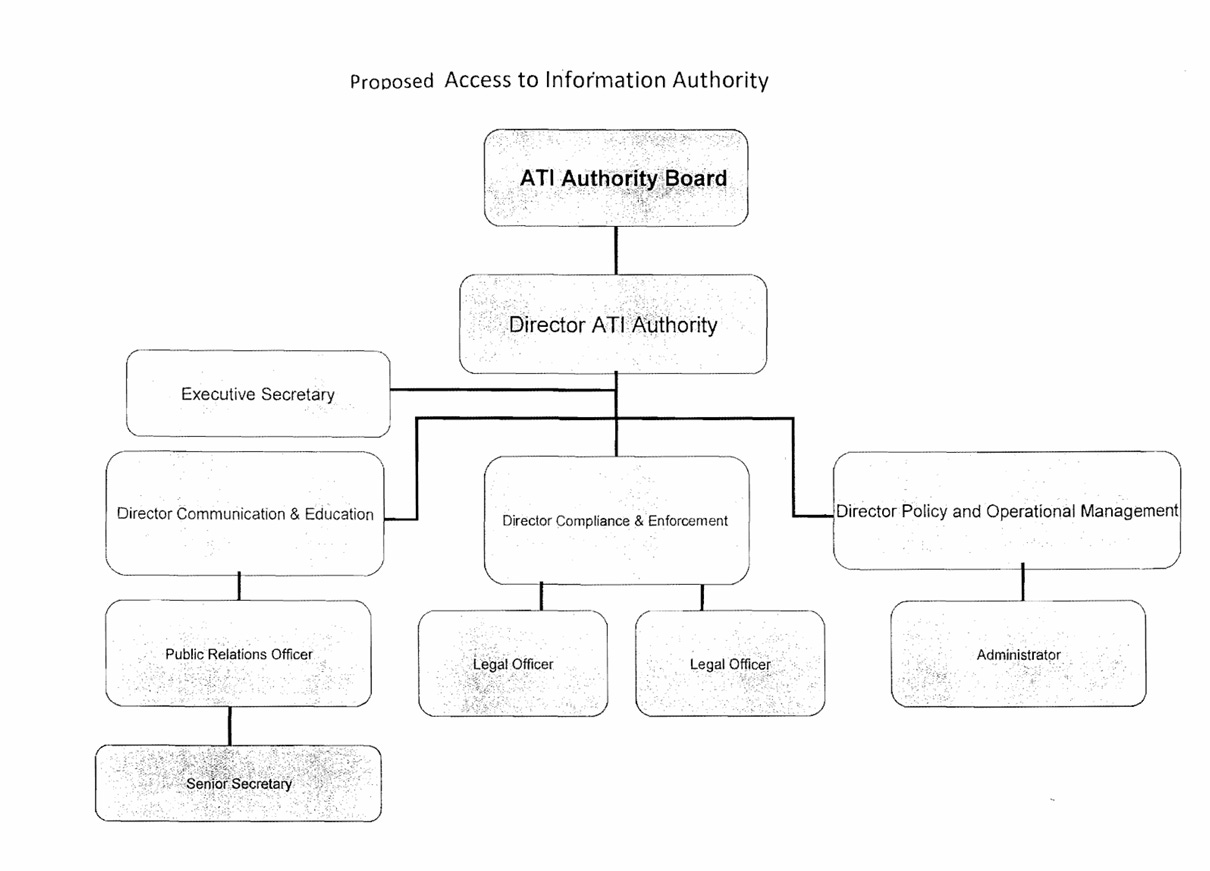
For this model to work, the independent arbiter would need to work fulltime for an ATI unit that would also have to become an independent body like the Integrity Commission.
In fact, under my proposed revamp, ALL references in the law to ministerial discretion would be removed from the Act and that discretion given to an independent ATI unit.
The independent ATI unit, as I envision it, would file its own annual reports, have its own enforcement branch and report to parliament rather than its current parent, Ministry of Education, Skills, Youth and Information.
Having an independent ATI unit with an independent arbiter would go a far way to stemming the tide of corruption in this country and reduce the perception, as in my NEPA case above, that the agency is withholding information because it relates to the prime minister.
Making the ATI unit a statutory body with enhanced monitoring and compliance functions, including preparing reports for the parliament, was among the reforms recommended by a Joint Select Committee (JSC) of Parliament in 2011. It also recommended exemptions like security, international relations, business affairs, and law enforcement be subject to a public interest test. Yet, 15 years later, those recommendations remain unimplemented. This is despite Section 38(1) of the ATI Act requiring that the law be reviewed by a committee of both Houses of Parliament appointed for that purpose “from time to time.”
In 2019, the Holness administration promised to announce yet another JSC to review the ATI Act “at the next sitting of Parliament.”
Seven years later, that still hasn’t happened despite the government having set another deadline by April 2025, which it has again missed.
At a July 15, 2026 post-Cabinet press briefing, Information Minister Dana Morris Dixon said the government’s approach was to first incorporate recommendations previously made by stakeholders into draft legislation, and then convene a JSC to consider that draft, rather than making the process open-ended.
But Morris Dixon didn’t give a firm date saying only that she hoped to begin the process by the end of this year.
Video: Information Minister Dana Morris Dixon on July 15, 2026 speaking on the timeline for convening a JSC to reform the ATI Act.
I have subsequently submitted recommendations to the ATI unit in hopes those changes will be incorporated into the draft legislation.
It’s been 24 years since the ATI Act passed, and no meaningful reform has come.
If Morris Dixon misses her own new timeline, the next step may be for us, the citizens, to find a way to challenge her slow action in court.
####
*ChatGPT used for research and editing, but I independently fact-checked everything before publication.
Related Stories
Ownership and Directorship of Estatebridge Development Clarified By Companies Office