

SUBSCRIBER CONTENT
Many years ago, I was sitting in the office of my doctor, who visibly wrestled with which lab to refer me to in order to get some basic bloodwork done. “Where should I send you to?” she openly asked herself.
Sometime before, she had easily referred my mom to a more expensive lab outside her office building for similar basic bloodwork even though one was situated a few steps from her office that offered a substantial discount to patients of doctors in that building — like her.
I sat there puzzled: why is this a headscratcher?
I had two thoughts: Maybe she thinks I don’t have as much money as my mom and would therefore benefit from the savings? Or…did she have a stake in the lab which she didn’t want to disclose and thought better than to refer me there because I am an investigative reporter?
To her credit, she referred me to the cheaper, more convenient lab. However, upon later research, I found that indeed, my doctor, who has now passed away, was professionally connected to the more expensive lab.
I thought to myself, “She should be disclosing this to her patients. My mom paid more for no good reason.” I told my mom but not my doctor because I didn’t want to make her uncomfortable.
But now, years later, I see that what I experienced as a small ethical lapse was actually a window into a bigger problem now surfacing at Jamaica’s premier publicly-funded hospital, University Hospital of the West indies (UHWI).
And just as that incident planted a seed of distrust in me of the medical profession, this bigger issue threatens to undermine public confidence in doctors on a wider scale, which could cause patients to delay seeking care, to disregard medical advice, and to risk eroding their support for vital public health programs.

Fast Forward To the Problems at UHWI
UHWI, in the country’s capital, Kingston, is where students from other Caribbean countries come to train as doctors and where other local hospitals send patients when they don’t have the technical capacity to care for them.
But at UHWI, patients can wait hours on end to get care. And when care finally arrives, basic medications and supplies are out of stock, leaving doctors little choice but to refer patients off-site.
Some doctors have turned this shortage into opportunity, establishing medical supply companies. One of those companies, as reported by The Gleaner in May 2011 and investigated by the then Office of the Contractor General (OCG), sold to patients, and as I later found from the OCG’s own public contracts database, the hospital, itself. (The OCG oddly found that there was no conflict of interest. It also found that the doctor in question, Peter Johnson— who was then head of radiology at UHWI — didn’t use his position to, directly or indirectly, influence patients’ purchasing behavior.)
The doctors are supposed to declare their conflicts of interest, but a document recently shared with me suggests resistance among doctors in doing so.
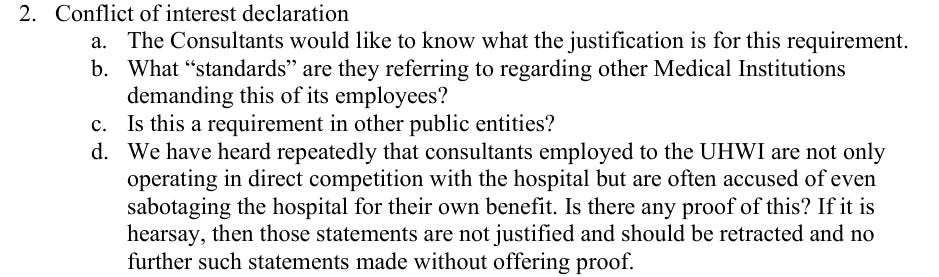
The document summarizes concerns stemming from an October 27, 2021 meeting of the UHWI arm of the Association of Government Medical Consultants (AGMC) — the senior doctors. Amid the litany of seemingly serious concerns like organizational structure, chain of command, overdue gratuities, lack of basic equipment and supplies, and having little say in which items are procured, they also seemed resistant to complying with a human resources directive to begin declaring their conflicts of interest — wanting to know, “What the justification is for this requirement.”
They also wanted to know, “What ‘standards’ are they referring to regarding other Medical Institutions demanding this of its employees?”
“Is this a requirement in other public entities?”

It’s discouraging that in an age where issues of good governance and best practices have been widely circulated, this is Jamaica’s senior educated set —our doctors — that feel they need to ask that question.
Is the concern that disclosure could cost doctors business? Even if it did, the senior doctors, especially, are already well compensated. One UHWI consultant recently showed me a pay stub reflecting monthly gross earnings of roughly $1.55 million (US$9,884), above the US$8,405 that the average Jamaican takes home in a year.
And what about disclosing to us patients? Do they not care what we pay?
If doctors are going to be capitalizing on an opportunity to sell medical supplies that the hospital doesn’t supply, the least they can do is to be upfront and say to the patient, “Here are three options where the devices can be purchased. Bear in mind, I own 50% of Company X, so shop around and do what’s best for you.”
What’s Required by the Medical Council of Jamaica
The Medical Council of Jamaica’s (MCJ) own ethics handbook instructs doctors to “always disclose to your patients any interest you may have in pharmacies and other health care or medical establishments to which you may be referring them.”
The handbook also states that when it comes to government contracts, doctors should disclose for any goods or services being offered for purchase their direct or indirect financial interest — including those of immediate family members — and that non-disclosure may amount to “serious professional misconduct.”
Jamaica’s Public Procurement Act, 2015 also requires procuring entities to exclude participants where a conflict of interest is likely to impair the integrity of proceedings and outlines penalties for unlawful influence or deception in procurement processes, including a fine of up to three million dollars, and, or imprisonment for up to three years.
And yet, earlier this month, 18° North reported that local medical supplies company, Medical Technologies (MEDITECH) Limited, despite having a family connection to UHWI’s chief doctor, Carl Bruce, was able to win tens of millions of dollars in contracts from the hospital between 2008 and 2020—the vast majority with only one bid received.
As Medical Chief of Staff in charge of clinical care at the hospital for around ten years, Bruce is an ex-officio member of the UHWI board of management, which sometimes interrogates procurement decisions, though it’s not known if any of MEDITECH’S contracts with UHWI were ever discussed at the board level.
Neither he nor the hospital answered when asked if he had declared this apparent conflict of interest or recused himself from any discussions involving the company. Three industry insiders —including MEDITECH’s former CEO - have hinted or alleged that Bruce, himself, is financially connected to the company, though Bruce has reportedly denied having any ownership in MEDITECH.
How This Can Affect Patient Care?
From the summary notes, the consultants also noted, “We have heard repeatedly that consultants employed to the UHWI are not only operating in direct competition with the hospital but are often accused of even sabotaging the hospital for their own benefit.”
Translated, Opposition Spokesperson on Health Dr. Alfred Dawes told me this could mean —without actually hearing of such allegations — that where UHWI-employed doctors, who also have connections to private companies doing CT scans, for example, may refer patients to that private entity instead of to UHWI, which provides the same CT scan service. Those conflicted doctors, he said, may be motivated to keep UHWI’s machines inoperable for as long as possible rather than report them to be repaired in the shortest possible timeframe.
To claims like this, the UHWI arm of the AGMC in its meeting notes questioned, “Is there any proof of this? If it is hearsay, then those statements are not justified and should be retracted and no further such statements made without offering proof.”
I don’t support making statements that are unproven, but why do we need proof of corruption in order to proactively prevent it? Declaration of conflicts of interest isn’t a punishment. It’s merely a prophylactic.
Already, the public’s confidence in UHWI has been shaken after a damning Auditor General report in January, which found that UHWI had failed to produce procurement documentation for 51 contracts valued at more than $521 million (US$3.3 million) and had misused its tax-exempt status to facilitate imports for several private companies, leading to revenue losses of more than $23 million (US$147,163).
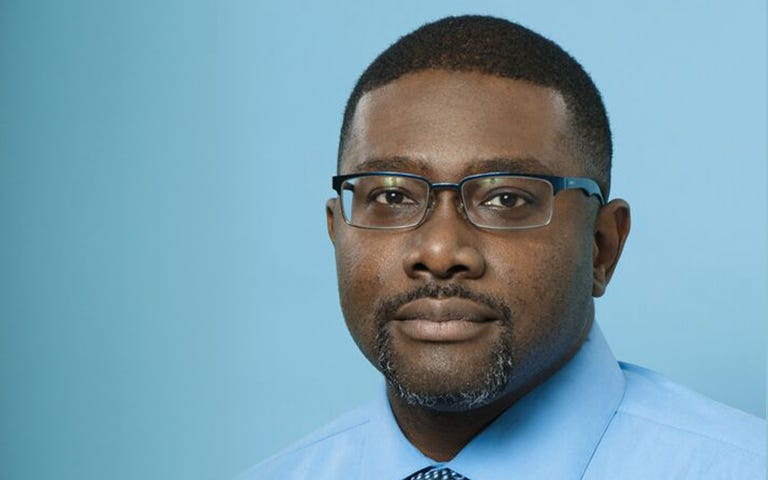
When recently contacted, the UHWI representative of the AGMC since 2019, Dr. Myrton Smith, seemed to understand the importance for doctors to declare their conflicts of interest. “We do not have an issue with that,” he said. He added that the doctors’ main issue from 2021 was the actual wording of the conflict-of-interest declaration form which would “sign away benefits” that had previously been negotiated for doctors who work in the public system to also work privately.
However, that concern about the wording was nowhere in the summary notes. And when Smith was asked for a copy of the document to prove that this was in fact the case, he said it was confidential and referred me to the human resources division of UHWI, which never sent the form despite my request.
Also requested of UHWI’s HR Senior Director, Duane Nelson, and the interim CEO, Eric Hosin, was whether the initiative to declare conflicts of interest was ever implemented. Smith said he doesn’t know of any of the doctors who have been on staff having to sign one but was unaware whether this was a requirement for new hires.
Another UHWI senior doctor, who is affiliated with a medical supplies company, told me he doesn’t declare his interest because his bosses don’t — a telling admission about institutional culture. However, he said the company with which he is affiliated also doesn’t do business with the government, nor does he recommend patients to buy supplies from the company.
In my view, annual declarations of conflicts of interest by all doctors— whether senior or junior, whether at UHWI or elsewhere in the private or public sectors —should be implemented at all institutions and should attract penalties if not disclosed to those institutions and to patients.
There should also be a requirement, as in the United States with the Physician Payments Sunshine Act, that pharmaceutical and medical device companies report payments made to physicians. Such reporting should be made public in a searchable database so that patients and the government’s accountability entities like the police, the Integrity Commission and the Auditor General’s Department, can be more informed about doctors’ conflicts. If companies fail to report these payments to doctors, they should be barred from getting government business.
The Integrity Commission may also need to start proactively looking at companies winning state healthcare business to see if they’re connected to doctors and whether there have been any procurement breaches.
The MCJ should require that a sign be hung in each doctor’s office reminding patients that when a doctor makes a referral, the doctors are to immediately and voluntarily disclose whether they have any conflicts.
Until such a system is up and running and to ensure we’re getting impartial medical advice, patients, too, may have to start asking the uncomfortable question the next time we’re referred: “Doc, do you or any of your family members have any financial connection to that business?”
####
Disclaimer: I, through my company, Global Reporters for the Caribbean, the parent company of 18° North, had provided production services to UHWI in or around 2018.
Editor’s Notes:
Dr. Alfred Dawes was also accused of being disingenuous recently by the youth arm of the Jamaica Labour Party, Young Jamaica, after speculation mounted that the company of Opposition MP Dennis Gordon, known as JACDEN, was one of the private companies who benefited from the misuse of UHWI’s tax-exempt status. Dawes, along with his photo, had been listed on JACDEN’s website as a consultant at the time of the Auditor General’s report. However, Dawes has since said he is not affiliated with JACDEN nor has he ever worked for the company, that his image was used without his permission, and that when he found out about it, he asked for his image to be removed. (I couldn’t find the picture when I recently went to the website.) JACDEN, for its part, has maintained its works with UHWI are compliant and didn’t cause or direct any of the cited procurement failings. Opposition Leader Mark Golding said at a Jan. 29 news conference that he had spoken to MP Gordon who maintains that he had done nothing wrong.
Related Stories