

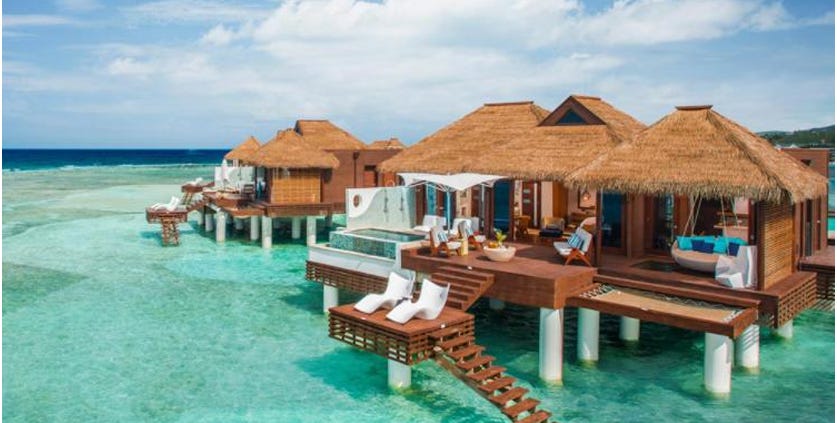
The Environmental Impact Assessment (EIA) public meeting on 19 August in Ocho Rios regarding Sandals 2022 application to build over-water villas in Mammee Bay was well-attended and indeed vibrant. The meeting had to be paused twice because of commotion caused by competing political aficionados at the back.
But the EIA process is deeply flawed. Many comments and questions would have benefitted from an immediate response from Sandals, but we were told the company’s answers would come later. Their only (formal) presence was at the start when their Regional Public Relations Manager regaled us with a long list of their community contributions. Unsurprisingly, one speaker pointed to the duplicity of this approach given corporate over-reach and Sandals controversies in several Caribbean locations.
The National Environmental Planning Authority (NEPA) attended only peripherally and in making the point that they had a duty to remain neutral regarding the pros and cons of the proposal, they would not explain why a change was made to local environmental regulations in 2025 that would allow such a development, subject to an EIA, when formerly it was out of the question in the Ocho Rios Marine Protected Area.
Questions were also raised as to the robustness of the EIA research especially regarding the representativeness of the many persons and organizations asked for their opinion of the Sandals proposal, and the framing of the questions asked of them. Several persons at the meeting who would be directly affected by the project said they were not amongst those surveyed. Persons canvassed for their opinion of the project were asked bland questions with no context offered. This was admitted by Paul Carroll from TEM Network Ltd., the entity that prepared the EIA document, which notes that “82.8% of the combined group of fishermen and excursionists interviewed having no knowledge of the proposed development.” Quite who were the “excursionists” on a beach which has limited to no public access was another question asked, and also who did the professionals surveyed include?
Many surveyed, and also at the meeting, said they welcomed the project because of the jobs it would create, over 100 during construction and 50 thereafter. Yet what of the costs? Many fishermen are fearful that they would no longer be able to fish in the area, as described in a Gleaner article dated Dec. 7, 2025 ‘Fishers uneasy over Sandals overwater villas at Mammee Bay’. The EIA surveys were done as far back as 2022 and since that time Mammee Bay has seen further reduction in beach access, generating widespread protests. It is significant that omitted from the list of relevant laws and regulations in the EIA document is the Prescription Act of 1882 that allows a person to gain a legal right (such as a right of way or access to water or land) by using it openly and continuously for 20 years without interruption. The Act is the basis of an ongoing court case regarding access to Mammee Bay beach.
Then there is the irreversible damage that would be done to the extensive sea grass beds and indeed the reef, with the villas extending over 150m out into the sea. The EIA likes the word ‘potential’ when describing the risks, but at other times that descriptor is correctly omitted. This collection of 18 villas, if allowed, would surely just be the start of similar mushrooming developments elsewhere along Jamaica’s pristine coastline with all the environmental damage and exclusion involved. Jamaica is clearly an attractive enough destination without such encroachments.
The EIA provides details of the alternative of building the villas on the land instead. The job benefits would be much the same without the environmental and social disruption. The description of this alternative given in the EIA is that of “luxury beachfront villas offering views, private pools and direct beach access within lush garden surroundings.” Surely this is enough of an enticement for wealthy visitors? Only Sandals would lose out a little, unable to charge quite as much as US$2,000 or more per night. If the staff working in the villas were paid premium (double?) wage rates, that might mean a little more local benefit. But if Sandals is so committed to Jamaica, why could they not use their ample profits to help facilitate greater supplies from more local farmers, and even encourage tourism diversity with Airbnb's from whom they could earn a commission?
Exclusive enclave tourism does not spread the benefits of the sector very widely in Jamaica. And it helps to cut visitors off from the rich socio-cultural environment which makes Jamaica stand out above sand/sea/sun-only destinations. Sandals in Negril is set well back from the water such that the beach is equally available to both locals and hotel guests who can mingle if they so choose. The same is true in Ocho Rios (Turtle) Bay with the Moon Palace and other hotels. Both show that it can be done without harassment being a problem.
I look forward to the time when full public access to Jamaica's beaches integrates hotel tourism into the mainstream of Jamaican life, with Mammee Bay beach leading the way. The larger goal must be comprehensive beach rights, not discretionary access controlled by government and the corporate sector. It is regrettable that the duplicitous Beach Access and Management Policy (BAMP) tabled in March 2026 leads us in the opposite direction.
Paul Ward
Oracabessa
The views expressed are not necessarily those of 18º North.
Send feedback to pgward72@gmail.com.
