

SUBSCRIBER CONTENT
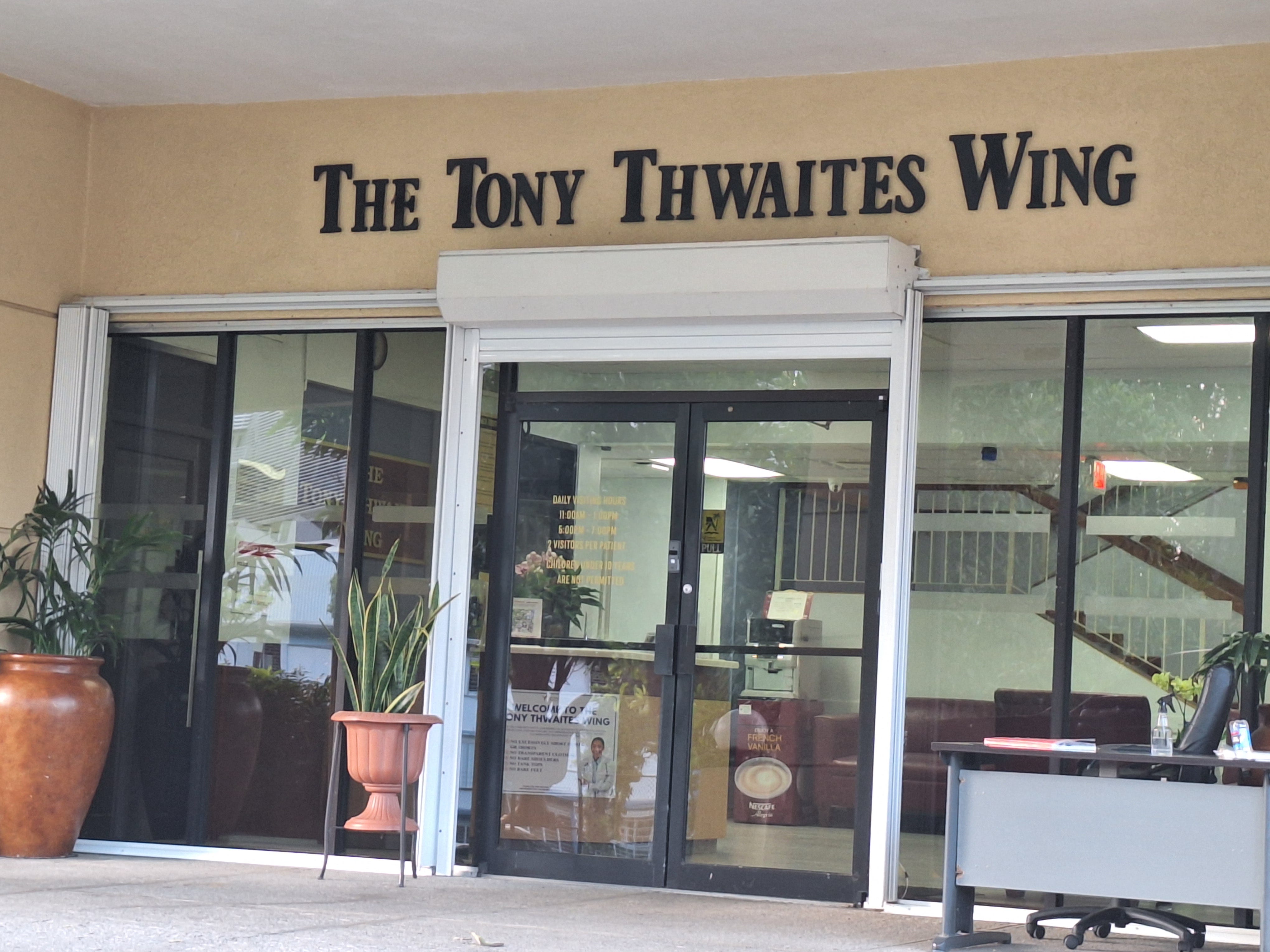
Conflicting explanations are casting new light on how the charity that operates the Tony Thwaites Wing at the University Hospital of the West Indies (UHWI) came to be used to facilitate duty-free imports for about J$5 billion (US$33 million) worth of goods, including some it didn’t own.
The review by the Auditor General’s Department (AudGen) of nearly 3,000 UHWI import entries from 2019 to 2025 made public in January showed how the charity, University Hospital of the West Indies Private Wing, was listed as the importer in all cases, along with its Taxpayer Registration Number (TRN), enabling an estimated J$1.49 billion (US$9.9 million) in customs duties to be waived even for some items belonging to private companies.
While the chairman of the charity, Mark Thwaites, denies approving the use of the charity in this way, his own explanation, the AudGen’s findings, financial records and 18° North’s interview with the customs broker raise questions about whether the charity itself enabled the environment for breaches and should be sanctioned.
Far less attention has been paid to the role of the Private Wing until now.
The AudGen analyzed 20 import entries in detail and found problems with eight.
Among those eight, were transactions involving two companies, which the public now knows to be Supreme Laundry Services and JACDEN Group of Companies, the latter being owned by a sitting People’s National Party (PNP) Member of Parliament, Dennis Gordon.
The AudGen found that the Private Wing in 2023 and 2024 was listed as the importer of laundry equipment, office furniture and dialysis machines for both companies altogether valued at about J$68.6 million (US$454,998), generating J$16.7 million (US$110,765) in duty waivers.
Auditors found no evidence that the imports were ever received or used at UHWI, yet still the hospital paid out around J$1.9 million (US$12,585) in other customs taxes and fees.
How the Private Wing’s Tax-Exempt Status Came to Be Used
In a recent interview with 18° North, Thwaites offered a shifting explanation for how the charity’s tax-exempt status came to be used.
“The acts that were facilitated were not approved by us,” he said at first.
Pressed further, he said the Private Wing’s manager may have assisted UHWI “once” in clearing a shipment pre-2019, before the practice continued “without our explicit approval.”
He also said the ability for this to have happened was because the charity and UHWI shared the same customs broker at the time.
“We have changed the broker,” he said. “We cannot have the same brokerage as UHWI.”
The Broker’s Account
The customs broker, Leon Senior of Executive Partners, says he wasn’t made aware he had been changed but had instead been instructed by the Private Wing’s lawyer to no longer use the tax-exempt status of the Private Wing to clear hospital goods, and he has complied.
He says he has handled imports for both UHWI and the Private Wing for about 25 years, though he didn’t handle the shipment for JACDEN.
Senior says he couldn’t have used the charity’s TRN and Tax Compliance Certificate (TCC) number, which is also required to clear goods duty-free, without authorization.
“I called Private Wing and said the hospital called me to use your TCC, and she said, ‘Go ahead, we had a meeting,’” Senior said, referring to a conversation years ago with the late manager of the Private Wing who died in 2022.
However, he didn’t answer when asked in a later WhatsApp message whether that authorization was only for one shipment or multiple ones.
How Application of Tax-Exempt Status Is Supposed to Work
At an April 28 Public Accounts Committee (PAC) hearing before Parliament, Acting Commissioner of Customs Kirk Benjamin suggested that a declaration is required from the tax-exempt entity stating that imported goods are for its use in order for duties to be waived.
Yet, the AudGen’s report only referenced declarations from UHWI—not the Private Wing—even though the charity was listed as one of the importers.
When asked by email whether Customs had received the required declarations from the Private Wing before clearing the goods and whether that would have been required, Customs claimed it wouldn’t be responding to 18° North due to confidentiality.
It’s since emerged from the PAC hearings that UHWI, though normally exempt from customs duty and GCT (sales tax) as a public body, hadn’t had a TCC since 2015 because it owed billions of dollars in other taxes and so was hampered in clearing goods duty-free on its own.
The Private Wing, being a registered charity with tax-exempt status and a similar name to UHWI, eventually became the hospital's mechanism to access those benefits.
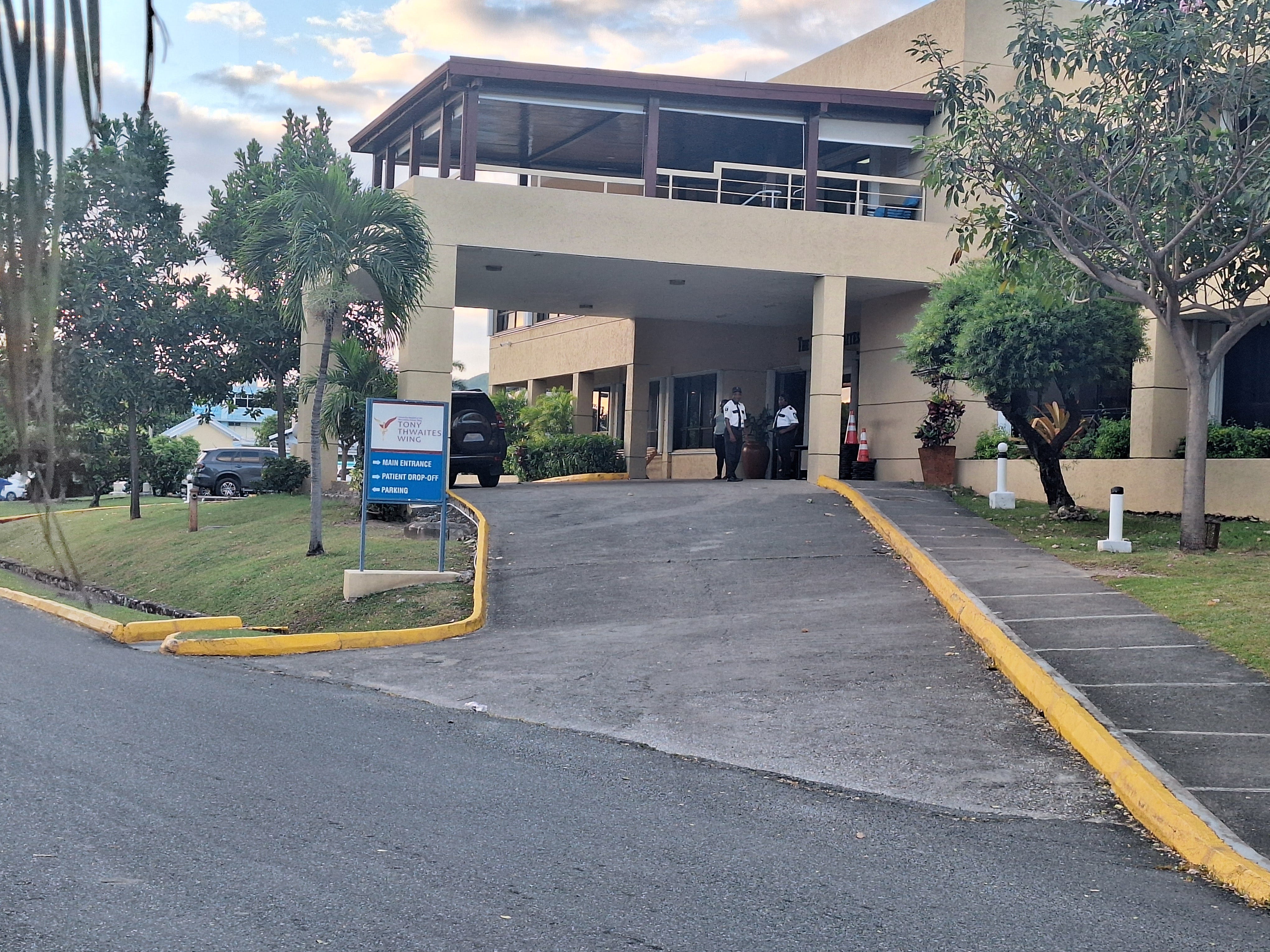
Why Was UHWI Using Private Wing’s Tax-Exempt Status
Asked during the hearing whether Customs, having provided a list of UHWI’s and Private Wing’s imports to the Parliament, was satisfied that the goods were legitimately for UHWI, Benjamin said his team would be conducting an audit to make that determination.
Even if the goods were for UHWI, Benjamin told 18° North after the hearing, “You can’t use your status to bring in goods for someone else.”
But inside the hearing, he had suggested that permissibility could depend on a charity’s mandate. Section 5(2)(a) of the Customs Act allows approved charities to import goods duty-free if the Commissioner is satisfied they are required for the organization’s charitable purposes.
In this case, however, it doesn’t appear to have been the Private Wing who was the true importer maintaining control over the transaction. It was more like the Private Wing’s tax-exempt status being used by a related entity, which was then further used to benefit private companies. Under Jamaican law, the fraudulent use of another’s tax identification details to commit an offence can attract criminal penalties, as does using a charity for a purpose outside of its charitable mandate. Making or causing to be made a false declaration to Customs can also carry hefty financial penalties.
Background
The UHWI Private Wing began operations in 1990 and is situated at the hospital.
Though set up as a separate legal entity, the Private Wing lists the hospital as a shareholder, and, according to its website, it operates “interdependently” with UHWI.
The Private Wing was originally financed by individual donors and major corporations like National Commercial Bank, GraceKennedy and Wray & Nephew Ltd. It generates revenue from fee-paying patients seeking upgraded amenities and recorded a J$196.4 million (US$1.3 million) net profit in its 2024 financial year, the latest on file at the Companies Office.
Some of its revenue is used to pay for monthly use of the hospital’s senior doctors, nursing staff and equipment provided to the Private Wing, according to Thwaites. He says more than a billion dollars’ worth of equipment has also been donated to the hospital over the years.
Those activities appear consistent with the stated mandate of the Private Wing, which includes helping provide financing to the hospital and acquiring equipment for the benefit of itself, UHWI and its patients.
But while supporting the hospital on some fronts, some practices of the Private Wing may have crossed legal and governance lines.
Loan Agreements That Helped UHWI Bypass Procurement Rules
According to its financials, for at least two decades, the Private Wing has been making financial outlays on behalf of the hospital and then deducting these amounts from the monthly monies it owes UHWI.


The problem with this is that UHWI, as a public institution, is bound by government procurement rules designed to promote competition among suppliers, ensuring the best value for money, while the Private Wing has more flexibility in how it acquires services and goods.
In its report, the AudGen flagged two deals in June 2019 and March 2023 worth J$91.66 million (US$607,946) and US$354,334 (J$53.4 million), respectively where the Private Wing purchased a Philips Digital Diagnost C50 Dual Panel machine and mobile C-Arm equipment for UHWI with bank financing. Repayment was to be deducted from future payments owed to the hospital.
Thwaites defended the loan agreements, saying the hospital had made urgent requests for equipment it couldn’t afford. “We save them because they get the time to pay it off,” he said.
But while framed as support, the AudGen said the arrangements resulted in UHWI “bypassing procurement processes” to acquire equipment despite the finance ministry’s warning that the proposed agreement fell outside procurement rules and required a detailed submission before sign-off. The AudGen said there was no indication that this was done.
A source told 18° North that both purchases were made through International Med-X, which UHWI had recommended to the Private Wing. While UHWI didn’t confirm that, co-owner Chris Isley acknowledged the sales and said the Florida-based company is Jamaica’s authorized dealer for Philips.
That doesn’t mean, however, that there weren’t other brands UHWI could have explored, and Thwaites acknowledged that the Private Wing doesn’t follow public procurement rules.
But International Med-X appears to have enjoyed preferred standing with UHWI. According to the Integrity Commission’s contracts database, the company received 51 UHWI contracts worth about $120 million (US$1.1 million) between 2010 and 2020, all awarded via sole source or direct contracting.
Possible Breaches of the Public Procurement Law
The AudGen highlighted that it was weaknesses in UHWI’s procurement planning that had “led to an ad hoc approach that often resulted in the frequent use of sole-source procurement methods and breaches of established regulations governing public procurement.”
The Public Procurement Act of 2015 penalizes anyone who engages in any fraudulent practices to avoid the requirements of the Act with a fine of up to three million dollars and/or up to three years in prison.
While further investigations may be necessary to determine whether there were violations of this Act by the Private Wing, coming out of the AudGen’s report, Thwaites said, things will be different now. He said, at the time, the Private Wing didn’t know it was helping the hospital flout the rules.
“We are going to make sure they follow what they need to follow,” he said.
Need for Scrutiny
The way in which the charity has been operating has drawn scrutiny from governance advocates.
“You can’t have your TRN being used by somebody and you don’t know about it,” Robert Stephens of the Advocates Network said. “What’s the use of the damn law if you’re going to set up systems to circumvent them?”
Under the Charities Act, 2013 a charity’s status can be suspended or revoked not only for serious crimes like fraud or dishonesty but also conduct that harms public trust.
The Makeup of the Board
The Private Wing’s board has included some of Jamaica’s most prominent business leaders over the years, including R. Danny Williams, a former Cabinet minister and insurance executive, who died in September 2023, and William McConnell of J. Wray & Nephew fame who passed away in 2018.
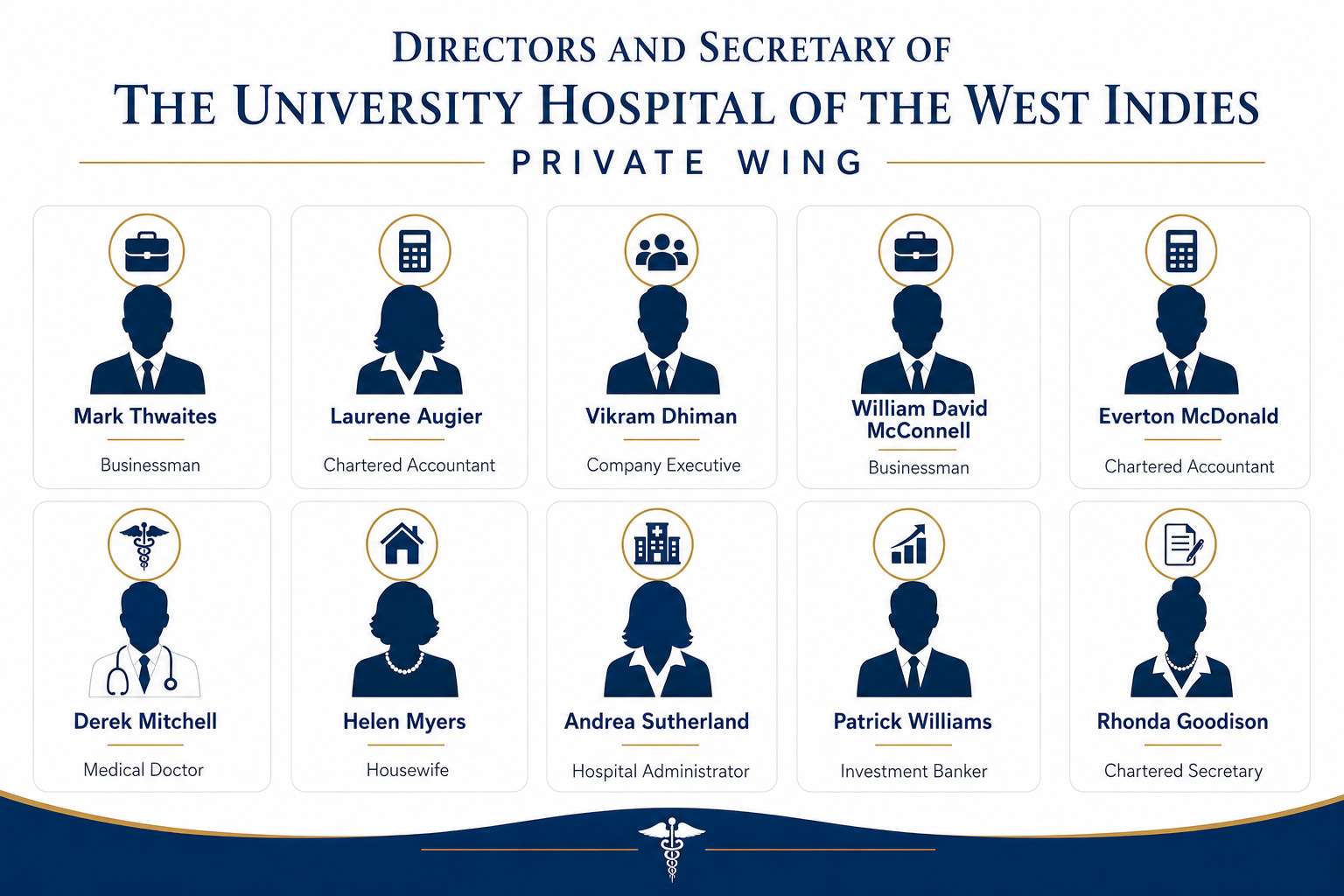
Along with Thwaites, company documents list the charity’s current directors as Andrea Sutherland, Everton McDonald, Laurene Augier, Derek Mitchell, Vikram Dhiman, William David McConnell, Helen Myers, and Patrick Williams —names that stand out in the world of hospital administration, accounting, medicine and business, raising questions about how such controversial practices continued for so long under the watch of such an experienced board.
Reached by phone, McDonald referred questions to Thwaites, while Williams said he was “woefully ignorant of what is going on,” that he doesn’t listen to news reports and that when he does go to the meetings, “invariably, I’m late.” The others either weren’t reached or didn’t respond to emailed requests for comment.
Neither the Department of Co-operatives and Friendly Societies which oversees charities, the Integrity Commission which investigates procurement breaches, or the Tax Administration Jamaica which grants tax-exempt status, has answered whether they plan to take any enforcement action against the Private Wing. Benjamin of Jamaica Customs declined to say if the Private Wing is part of any investigation.
The Private Wing didn’t answer whether it had reported the alleged misuse of its tax-exempt status to the police.
####
Editor’s Notes
Writing and editing help and graphic creation by ChatGPT.
The UHWI now has a temporary TCC of its own.
The exchange rate used to convert the contract awards database amounts between 2010-2020 is J$113.86:US$1, based on the average of the average sell rate for each of those years on the Bank of Jamaica website. All other rates were calculated based on the average of the average sell rates for each of the years 2019 to 2025, which equates to J$150.77:US$1.