

SUBSCRIBER CONTENT
Before Hurricane Melissa ravaged western Jamaica last year, the only other post-Independence event to have wiped out two-fifths of Jamaica’s GDP was the meltdown of the financial sector in the 1990s.
The PJ Patterson-led government of the day set up the Financial Sector Adjustment Company (FINSAC) to bail out some financial institutions and take over others, saddling it with bad loans and some of the underlying real estate assets.
The intervention by FINSAC caused the government to bleed billions of Jamaican dollars, making it desperate for cash.
Now a confidential report that has not been previously reported publicly is showing how that desperation coupled with FINSAC having “engaged the services of an unqualified valuator, Michael McNaughton,” led to the disposal of valuable assets that were “severely under-priced,” lowering returns to the state-owned company.
By the government accepting less, not only were taxpayers disadvantaged, according to FINSAC victim Yola Gray-Baker, but debtors like herself may have been able to get some support from the state had the assets been sold for what they were truly worth.
Instead, she argues, after being forced to sell or give up homes and businesses to pay off loans at astronomical interest rates —north of 100% in her case —stemming from the government’s high-interest rate policy of the day to combat inflation, “the debtors got nothing.”
FINSAC “Ignored Previous Valuation Reports”
The 20-page confidential report, obtained under the Access to Information Act by 18° North from the Ministry of Finance, was authored by management consultant, Dennis L. Boothe, who, himself, served as FINSAC’s Managing Director and as a director of one of its subsidiaries, Refin Trust.
At the time of the report on Dec. 11, 2008, however, Boothe was as an advisor to the then minister of finance, having ended his tenure running FINSAC between January 1997 and June 1998, according to his LinkedIn profile. Patrick Hylton had taken over.
For two major properties, the report stated that FINSAC “appears to have ignored” previous valuation reports prepared by reputable appraisers, opting instead to rely on “a single appraisal” from McNaughton, resulting in the properties being “severely underpriced.”
One of the properties was the then Mutual Life Centre, which is today the set of twin towers at the corner of Old Hope Road and Oxford Road that houses government offices like the Ministry of National Security.
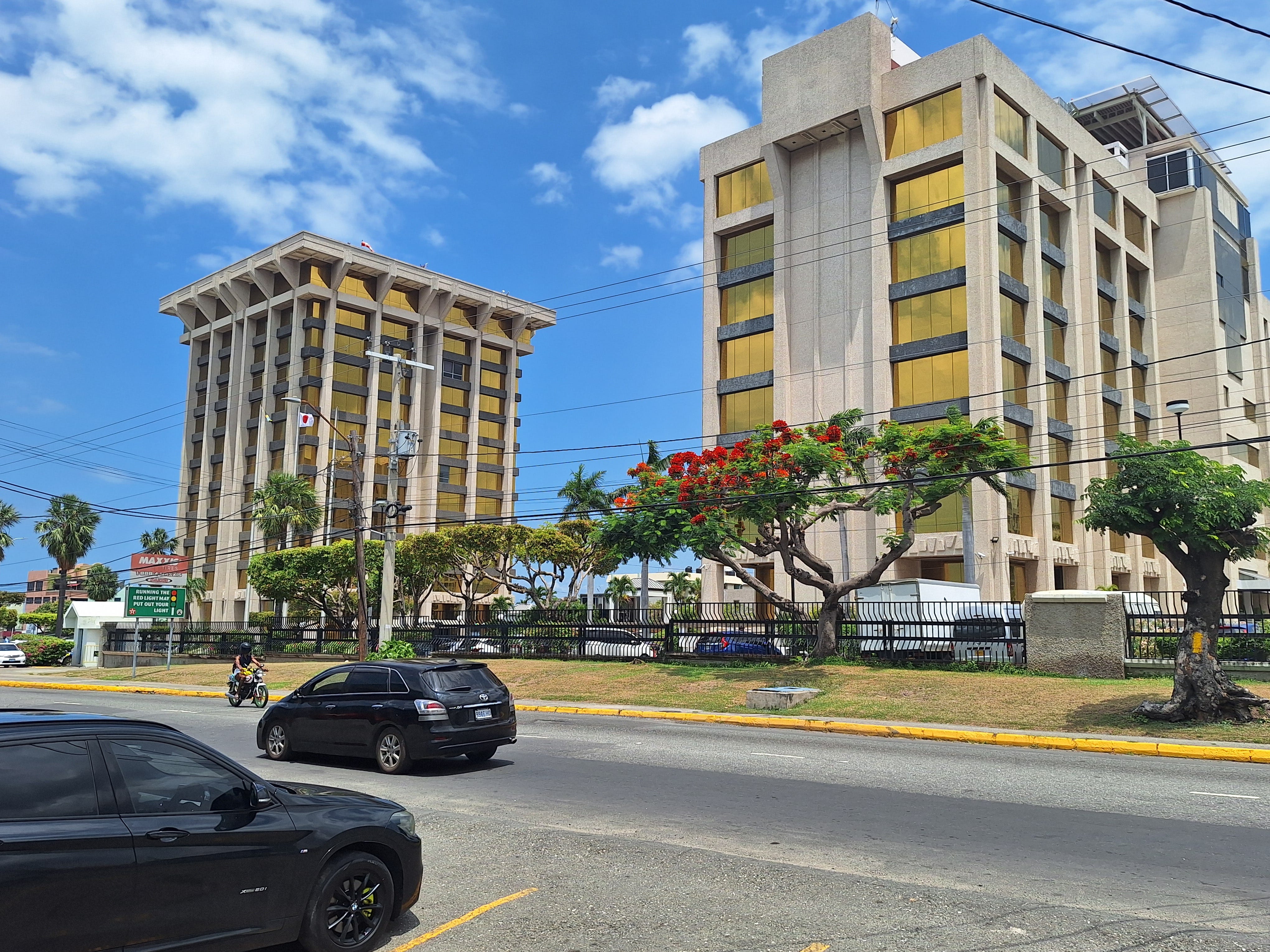
According to the report, FINSAC agreed to sell the property to Michael Lee Chin’s AIC for J$650 million (US$13.4 million) in 2002 based on McNaughton’s appraisal, even though it had been previously valued in 1997 by Allison Pitter & Company at J$1.15 billion (US$32.4 million) with a replacement cost of J$3.4 billion (US$94.9 million). That same year in 1997, it was also valued by Real Estate (Consolidated) Ltd. at J$1.4 billion (US$39.5 million) with a replacement cost of J$2.8 billion (US$79 million).
AIC went on to purchase the government’s majority shareholding in National Commercial Bank (NCB) from FINSAC at a price that Boothe also determined appeared “low.” Neither Boothe nor Lee Chin responded to 18° North’s requests for comment.
Mutual Life Towers — Fire Sale or Not?
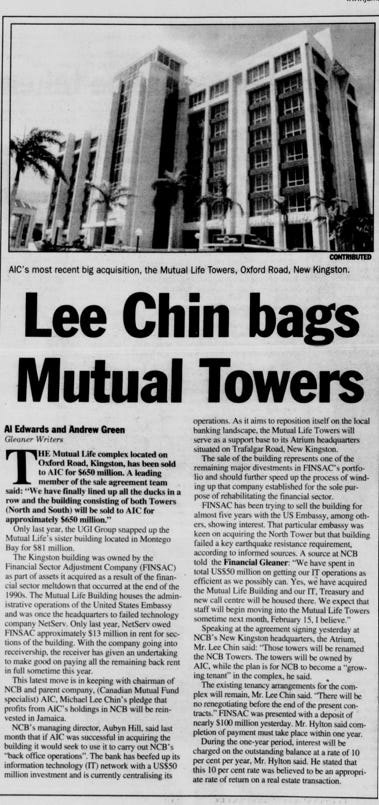
“FINSAC was aware that the offer made by AIC for the Mutual Life Centre was very low but seemed to be in a desperate hurry to sell the complex,” the report observed. In a May 20, 2002 letter to AIC, FINSAC Managing Director Patrick Hylton pointed out that the “discount rate used to value the premises was too high, and therefore depressed the value of the property.” The files indicated that the directors were also of the view that the sale price was low.
Despite the low price and the fact that the government needed cash, FINSAC turned around and sweetened the deal even more with generous terms of payment to the purchasers -- a deposit of 15% of the purchase price or J$97.5 million (US$2 million) and the remaining $552.5 million (US$11.4 million) financed by a vendor’s mortgage. This vendor’s mortgage was payable over one year after completion at a rate of 10% per annum payable in two installments.
It’s not known how or why, in the end, FINSAC accepted such a low price on such favorable terms for the Mutual Life Centre, and Hylton didn’t answer his phone or a WhatsApp message seeking comment.
However, a 2003 article in The Financial Gleaner about the sale to AIC noted that FINSAC had been trying to sell the property for almost five years.
Hylton went on to become deputy head of NCB in 2003, according to the government’s Jamaica Information Service and later assumed the top job at that bank. But in 2011, he publicly denied that the sale of NCB to AIC from FINSAC in 2002 was linked to him getting the NCB post.
Was McNaughton Held to Account?
According to the report, another commercial real estate asset, Life of Jamaica Towers on Dominica Drive, was similarly sold for a depressed price based on a single appraisal from McNaughton.
The report stated that the reports presented by McNaughton to FINSAC were not valuations and were instead titled “Property Inspection Form for Commercial Real Estate.” But according to Boothe’s report, it appeared to be common knowledge in the real estate profession that that, though unlicensed, McNaughton had been engaged to perform appraisals for FINSAC’s larger properties.
At no time was McNaughton licensed as a dealer -- he was only a registered salesman -- according to the report. Boothe outlined that on October 21, 2008, he’d gotten confirmation from the Real Estate Board that McNaughton was not registered or licensed to give any valuation or appraisal of real estate. Therefore, he concluded, McNaughton “possessed neither the requisite expertise nor qualifications to undertake such large assignments.”
Boothe recommended that an investigation be undertaken into the circumstances surrounding McNaughton’s engagement and that he be reported to the Real Estate Board so that legal action could be instituted against him for violating its regulations.
However, when contacted about whether action was ever taken against McNaughton, the Real Estate Board confirmed he wasn’t licensed to give appraisals but didn’t go further.
For his part, McNaughton was adamant he didn’t carry out a valuation of the properties but rather provided an “opinion” on the value of the properties for which he was paid. When pressed who contracted him to provide this opinion, as he claimed, McNaughton declined to answer merely stating, “it was so long ago almost 30 years now.”
We asked whether it was FINSAC that engaged his services or paid him, but McNaughton responded “no” adding, “you have your research to be done.” However, his response leaves more questions than answers like who exactly contracted him and why him of all persons to deliver an opinion on the value of the property if he was unqualified to carry out a valuation? More importantly, why did FINSAC sell the properties merely based on an opinion and not a proper valuation, as would normally be done?
A profile of McNaughton on the website of the Jamaica Stock Exchange, where he’s a board member, shows that he had worked as an independent consultant to NCB, Finsac Limited, Beal Bank, and Ocwen Financial Corporation through Dennis Joslin & Co. (McNaughton says NCB was a separate engagement.)
Dennis Joslin Jamaica, Inc. was initially engaged to administer FINSAC’s loan portfolio, according to Boothe in a separate report. The portfolio of non-performing loans was subsequently sold to Jamaica Redevelopment Foundation Inc., reportedly a subsidiary of Beal Bank based in Texas.
Not Exercising Fiduciary Responsibility
In his report, Boothe detailed FINSAC’s failure to exercise prudence in establishing the market value of several major properties by obtaining a minimum of two recent valuations, including one from the Commissioner of Lands.
He also accused the state entity of placing its commercial property holdings on the market at the same time and listing them with more than 50 real estate brokers that created “a glut in the market,” leading to the disposal of valuable assets at “bargain basement prices.”
He also outlined how, for the disposal of some assets, FINSAC appeared to have disregarded the long-established practice adopted by the government of appointing divestment committees under the guidance of the state-owned Development Bank of Jamaica (DBJ) despite evidence that, where these committees were used in offloading other assets, “the process appeared to have been carefully planned, transparent and resulted in a fair purchase price.”
Bitter Medicine for FINSAC Victims
To Gray-Baker, the revelation about the engagement of McNaughton is still relevant today as she is hoping to convince the government this year that victims should receive compensation.
According to Boothe’s report, having bailed out the banks, FINSAC had initially considered revitalizing some businesses that had been affected by the government’s high-interest rate policy in the 1990s, which would have involved restructuring loans—an initiative they had begun to pursue. However,” the exercise was made difficult” when the non-performing loans were eventually sold to a foreign collections agency, files were transferred offsite and staff left, which hindered the retrieval of information.
Though the Bruce Golding-led government had established a Commission of Enquiry into FINSAC back in 2008, no final report has been forthcoming and may never come. Only submissions to the Enquiry were made public on the Ministry of Finance’s website in 2024.
According to then Finance Minister Dr. Nigel Clarke, the Cabinet lost confidence in the ability of the commissioners to deliver a final report even after making additional injections of cash.
Without the final report, it’s been difficult for the victims to know where culpability rests, and how, even decades later, they can go about getting financial relief.
With Boothe concluding that in the process of disposal of assets, “there were clear instances of incompetence and poor judgment on the part of the board and management of FINSAC,” this newly-unearthed document may go some of the way in helping fill the information gap for some FINSAC victims.
####
With reporting by Zahra Burton.
Editor’s Notes:
Exchange rates used for the real estate values for 2002 and 1997 are J$48.56 and J$35.45, respectively. These are the average sell rates on the Bank of Jamaica’s website for each of those years.
