

SUBSCRIBER CONTENT
Video: Dr. Christopher Tufton featured in one of the Jamaica Moves videos.
The Oct. 7 Integrity Commission (IC) report found that Health Minister Dr. Christopher Tufton “could reasonably be considered to have indirectly influenced” the engagement of Market Me Consulting Limited by his ministry—a company co-owned by his friend, Lyndsey McDonnough, and later awarded almost $80 million (US$563,819) in no-bid contracts from the health ministry and one of its agencies.
Despite that finding, the IC stopped short of recommending prosecution, instead referring the matter to the Speaker of the House—a move typically reserved for breaches of conduct, not procurement law.
Tufton admitted having been McDonnough’s friend since 2011-- before Market Me was incorporated in 2013 and before he became Minister of Health and Wellness in March 2016.
And yet, evidence submitted to the IC by the ministry’s then-Permanent Secretary Dr. Kevin Harvey and its then-Manager Public Relations and Communications Stephanie Shaw Smith showed it was:
Tufton who introduced Market Me to the ministry upon taking office.
Tufton who asked that Market Me be involved in all PR activities related to his role before the ministry had ever contracted with the company.
And Tufton who pushed for the company to present its proposal for its physical activity program, Jamaica Moves, though another firm, OGM Integrated Communications, already had a contract for a similar program, Make It Count.
Director of Investigation (DI) Kevon Stephenson concluded that the rules required Tufton to have formally declared a conflict of interest, but he didn’t. And still, the DI didn’t recommend a criminal sanction.
While the IC has since explained why the DI declined to do so, based on an analysis by 18º North, the reason still seems inadequate for a public wanting to know where’s the accountability in Jamaica’s governance system?
Procurement Rules on Conflict of Interest
At the time of Market Me’s first Jamaica Moves no-bid contract in 2017, valued at $15.8 million (US$113,444), the governing rules were The Contractor General Act – Public Sector Procurement Regulations, 2008, and the Government of Jamaica Handbook of Public Sector Procurement Procedures (Revised 2014).
Regulation 36(1) of the 2008 legislation required any public officer, even if indirectly involved in procurement, like preparation of bidding documents or evaluation, to declare any conflict of interest and refrain from being involved in decision-making or implementation of the contract where such a relationship exists.
Section 4.2.1 of the GOJ Handbook states a conflict of interest will arise when the individual has a direct or indirect relationship with a contractor, which may affect or might reasonably be deemed by others, to affect impartiality on any matter related to his/her duties.
And yet, despite the fact that it was his friend’s business, Tufton was arguably involved in implementation since he was the face of Jamaica Moves, appearing widely in the media. He also arguably participated in the preparation part of the procurement process, since, according to the IC report, he was “integrally involved” in a number of meetings to discuss Jamaica Moves, even at its proposal stage.
Shaw Smith told the DI about one such meeting over a weekend at Market Me’s office with Tufton and McDonnough, where in addition to Jamaica Moves, they also discussed OGM’s Make It Count. Another meeting, which Tufton confirmed attending, was Market Me’s July 2016 presentation to the ministry.
Former PS Harvey told investigators that before Market Me’s presentation on Jamaica Moves, *OGM Integrated had already made its pitch for a similar healthy lifestyle program at one of Tufton’s previous senior management briefings.
He recalled how after Market Me’s presentation, “the HMH [Honourable Minister of Health] asked that myself and the technical team responsible meet with Market Me to further discuss the proposal.”
Harvey also confirmed a third meeting where the ministry outlined deficiencies of Market Me’s proposal and advised the company to submit a detailed written one if it intended to submit an unsolicited proposal.
The health ministry would indeed go on to submit an unsolicited proposal from Market Me to the National Contracts Commission (NCC), which approved direct contracting in December 2016, allowing the ministry to bypass the competitive process.
The Unsolicited Proposal That Really Wasn’t Unsolicited
But the DI, who is an attorney, found that the circumstances under which the ministry accepted Market Me’s unsolicited proposal weren’t financially prudent and weren’t justified since OGM had already been engaged for a similar campaign, and unsolicited proposals are supposed to be unique and not resemble a recent or pending competitive tender. Stephenson also noted that unsolicited proposals must be submitted without influence from the procuring entity, and ministry officials, at Tufton’s prompting, had given Market Me feedback on its proposal’s deficiencies before the firm was allowed to resubmit it, which provided an “unfair advantage” to Market Me.
As a result, the DI ruled that the use of the unsolicited proposal method breached Section 1.2 of the GOJ Handbook and the opportunity should have gone to competitive tendering. However, he didn’t recommend prosecution of the ministry or NCC officials and didn’t explain why he declined to do so.

The Question of Accountability
Procurement consultant Ricardo Bailey at DRB Group told 18º North it was the permanent secretary’s duty to have advised the minister on what was permissible. But PS Harvey left the ministry in July 2016, about a year before the contract was eventually signed in June 2017, and the report didn’t clarify whether his immediate successor, Elaine Foster-Allen, knew of Harvey’s prior missteps before submitting Market Me’s unsolicited proposal to the NCC.
Asked if he influenced Market Me’s proposal, Tufton told investigators: “I gave no instructions to anyone to award the contract to Market Me.” However, he said, “Given the policy direction that I wish to embark upon it would be expected that contracts awarded by the Ministry to execute policy on wellness and lifestyle matters such as Jamaica Moves project would be in harmony with policy objectives articulated by me as Minister.”
With that, Stephenson concluded that while there was no evidence Tufton directly instructed anyone, he “gave directives” to his permanent secretary that could, “to the mind of the reasonable and detached observer, be construed as an indirect instruction to engage the entity by way of contract(s).”
And though finding that Tufton’s actions gave rise to, “at its lowest, a perceived conflict of interest,” where, in his public function, he advanced a private interest which resulted in a monetary benefit to his friend’s business that contravened “principles” of transparency and good governance, Stephenson stopped short of saying that his actions violated the law.
Why the IC Didn’t Refer Tufton for Prosecution
When asked by email why the DI didn’t make a criminal referral, the IC responded that “a referral for prosecutorial consideration would not have been appropriate” because the evidence was “insufficient to prove some of the elements of the potential offenses to the required standard (beyond reasonable doubt).”
It also cited as a “significant hurdle” the definition of “personal relationship” under Regulation 36(5) of the 2008 Regulations which is “consanguinity or affinity up to the third civil degree,” meaning relations by blood or marriage.
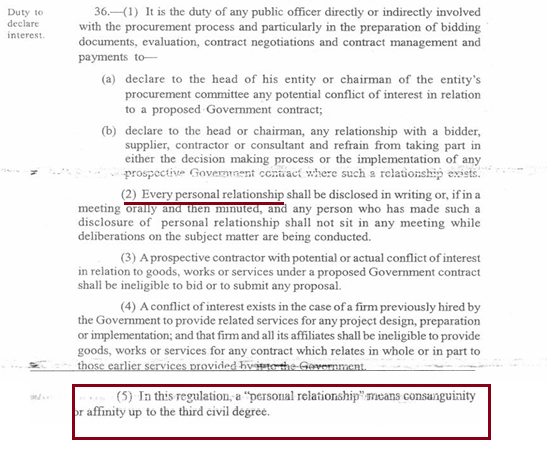
It’s not fully clear why the IC felt the definition of “personal relationship” mattered, but after Regulation 36(1) gives the circumstances where conflicts of interest must be declared, subparagraph (2) states: Every personal relationship shall be disclosed in writing or, if in a meeting orally and then minuted...
Even though Tufton admitted to the DI having “a personal relationship/friendship” with Ms. McDonnough, Stephenson appears to have concluded that their connection didn’t meet the legal threshold.
A Different Standard?
That reasoning, however, seems inconsistent with an IC probe released in 2023 where Stephenson referred Prime Minister Dr. Andrew Holness for prosecution under the same 2008 Regulations after finding he “may have influenced” contracts for works in his constituency in 2007 and 2009 to Westcon Construction, linked to his business associate Robert Garvin. There was no indication Holness and Garvin were related by blood or marriage, yet Stephenson deemed their “personal affiliation” as enough for a referral.
In that case, after considering Regulation 36(1)(a) and 36(1)(b), which mandate declaration of “any” potential conflict of interest or “any” relationship with a bidder or supplier, the IC’s Director of Corruption Prosecution (DCP) declined to charge Holness —not because of the personal relationship definition in 36(5), but due to insufficient proof of procurement interference since the guidelines surrounding constituency contracts weren’t fully established at the time. Why the standard is different in the case of Tufton and McDonnough’s relationship has not been answered by the IC.
A Way Around "Personal Relationship”
Even if the “personal relationship” clause in Regulation 36(5) of the 2008 law was a hurdle, some legal minds consulted by 18º North agree that the DI could have relied on other provisions of that same law to recommend charges.
Regulation 7 required adherence to the GOJ Handbook—which the DI itself found was breached when the ministry improperly used the unsolicited proposal method to hire Market Me even though it had the blessing of the NCC. Regulations 35 and 38 dealt with confidentiality in procurement matters, yet Shaw Smith told investigators that she, Tufton and McDonnough discussed OGM’s Make It Count campaign at Market Me’s office—suggesting a breach. Regulation 36(3) stated point blank that a contractor with potential or actual conflict of interest is ineligible to submit a proposal, and Market Me, whose co-owner was Tufton’s friend, had not just submitted a proposal, but had also gotten almost $80 million worth of ministry contracts.
According to Regulation 40, the penalty for direct breaches of the Regulations —and also for aiding or abetting them — was a fine of up to $1,000 (US$7) and, or three months in prison. This raises a question of why the DI didn’t refer ministry officials for prosecution for having breached the law and then similarly recommend Tufton for having incited those breaches?
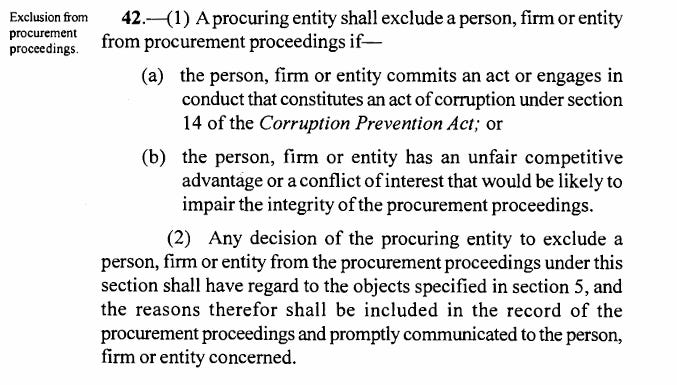
The DI might also have pursued violations under The Public Procurement Act, 2015, which, when it was effectuated on April 1, 2019, **repealed the 2008 Regulations and doesn’t contain that personal relationship clause. Section 42(1)(b) of that Act broadly requires procuring entities to exclude contractors with an unfair competitive advantage “or” conflict of interest but doesn’t specifically define those terms. Since the DI had found both a perceived conflict of interest and an unfair advantage in Market Me’s first no-bid Jamaica Moves contract, Stephenson could have argued that even one of those issues tainted some of Market Me’s later contracts between 2019 and 2021 that would have been governed by this newer legislation -- ultimately because of Tufton’s influence.
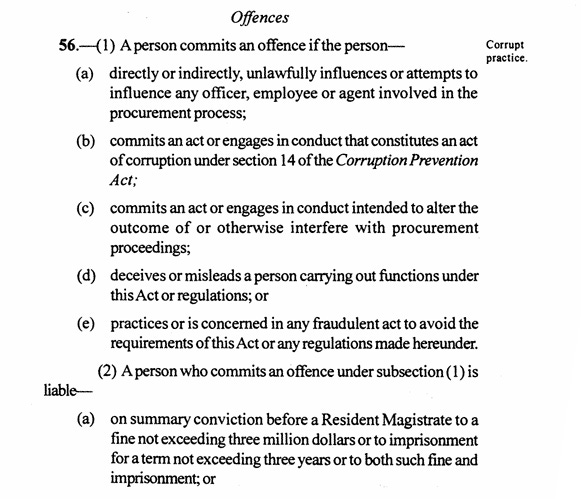
The penalty under Section 56(1)(a) for any person who unlawfully influences or attempts to influence an officer involved in the procurement process, even if indirectly, is up to $3 million (US$21,525) and, or three years in prison.

Instead, the only referral he made on those later contracts —a few of which were found to be in breach of the procurement rules because they exceeded the direct-contracting threshold —was to the permanent secretary for “appropriate action” and for a determination to be made as to whether there needed to be recovery of any loss.
What About Financial Benefit, Other Lines of Enquiry?
There was also the common law offense of misconduct in a public office available to the DI that he didn’t use. In the Westcon ruling, for instance, the DCP evaluated a recommendation to formally accuse Holness of that charge, but she ultimately declined to do so because of not enough evidence. In his investigation report, the DI had referred Holness for possible breaches of The Corruption (Prevention) Act, which the DCP didn’t address in her ruling. Why didn’t the DI similarly refer Tufton or at least explain why he didn’t do so, as he’s done in a previous report?
There’s also no sign the DI investigated whether Tufton got money from Market Me, even though the IC would have had access to his statutory declarations with information about his bank accounts, and the IC didn’t respond to 18º North when asked if that was done.
The enquiry may have been warranted because in an April 2024 Gleaner op-ed, Tufton appeared to claim partial credit for conceptualizing Jamaica Moves, contradicting both his and McDonnough’s statements to the DI that the program was Market Me’s idea. He wrote, “The concern and concept I was clear on. The name and branding were done through collaboration with one of the craziest (creative crazy) but brilliant creative thinkers I knew at the time. Jamaica Moves (JaMoves) was born.”
Was that brilliant, creative thinker McDonnough?
Tufton also wrote that “we creatively packaged selected corporate brands” to fund Jamaica Moves before government financial support. But who was “we” — Tufton and McDonnough, or Tufton and the ministry, which admitted in 2020 it launched the initiative in April 2017 with private sector funding before Market Me’s June 2017 contract? Who benefited from that funding and the “in excess of $75 million” (US$538,136) in private contributions that Market Me had said in 2020 supported the program?
Though the firm seemed to claim most of those funds went directly to suppliers, the IC should have verified and examined this if it found it had jurisdiction. Tufton did tell the DI, “I do not have a business relationship with Ms. McDonnough” aside from her firm’s ministry contracts and work done in his constituency “on a voluntary and professional basis.”
But why was the co-owner of a health ministry contractor providing voluntary work to the health minister’s constituency? When was that work provided, what was its value, and should it have been declared? The DI didn’t go into that. Parliamentarians are required to report on their statutory declarations to the Integrity Commission gifts they receive valued at over $100,000, but it’s not known if voluntary work provided to a parliamentarian’s constituency would fall into that category.
The DI also appears to have overlooked publicly available information.
For example, 18º North had published evidence in 2022 showing that Tufton had pushed for an agency of his ministry, the National Health Fund (NHF), to fund Jamaica Moves even though it was a ministry initiative. The evidence showed he had also attended the meeting of the NHF board where Jamaica Moves’ initial funding was approved, and he had also helped to oversee its implementation. Yet there’s no indication investigators used this material or questioned NHF board members or officials about Tufton’s involvement. Key witnesses also appear to have been missed like Permanent Secretary Foster-Allen, who came in 2016 immediately after Harvey, and the PS who followed her in 2017, Sancia Bennett-Templer.
Those interviews could have been useful because when the DI interviewed Permanent Secretary Dunstan Bryan, who came to the ministry in 2018 and who oversaw the $38.9 million (US$279,341) Jamaica Moves contract to Market Me in 2019, Bryan gave him a key detail to help him prove Tufton’s further involvement in the procurement process. “The Minister and I discussed the implementation of activities related to the Jamaica Moves Campaign,” he told the DI. He also stated “the issue of outstanding payments to Market Me was raised with me in January 2019” in response to a question about the minister’s involvement.
If Bryan was indeed referring to the minister, why was Tufton raising the issue of outstanding payments to Market Me if it was his friend’s firm?
Referral to the Speaker
Stephenson did refer the matter to the Speaker of the House, but he didn’t say what he hoped the referral would achieve.
Without specifically saying it, maybe he felt that Tufton had violated the principles of Ministry Paper No. 19/2002, Conduct of Ministers, which he cited in the body of the report, and which states that ministers must act solely in the public interest and declare private interests relating to their public duties.
Tufton, meanwhile, publicly framed the report as representing “vindication.” In an interview that aired on an Oct. 8 edition of TVJ’s All Angles, he noted that the IC had found “no evidence of pursuing the matter beyond having a discussion with the Speaker.” The Health Ministry also claimed the report found “no malfeasance.”
But Jamaica Accountability Meter Portal (JAMP) Executive Director Jeanette Calder, who appeared on the same program, disagreed, saying multiple procurement breaches occurred. “If you’re violating laws and regulations and the ministry doesn’t see that as a wrongdoing, the public has reason to be concerned,” she said. “And if the minister doesn’t see violations of public procurement laws that safeguard and protect our assets and funds as illegality then we really have to have a serious conversation about who the minister reports to.” (Calder has always maintained that parliamentarians report to taxpayers.)
The Larger Question of Accountability
The DI’s only potential referral for prosecution against ministry officials was their failure to submit certain Market Me contracts to the IC’s Quarterly Contract Awards database, a compilation of contracts issued by public bodies. But even that collapsed due to “evidentiary gaps,” including the absence of a key requisition once issued by the IC’s predecessor, Office of the Contractor General, requiring the submission of details of contracts.
That this was his strongest prosecutable point—and still fell apart—doesn’t feel like enough for an entity whose job it is to pursue accountability.
Given the weight these reports carry in shaping conduct, the DI should still clarify in more detail, even now, why no charges were recommended and how procurement accountability laws can be strengthened, like he’s done in a previous report. He should perhaps also be brought before the parliament’s Integrity Commission Oversight Committee to explain his reasoning.
Without clearer explanations and consistency, such findings risk normalizing political influence as “policy direction.”
After five years of investigation, the public deserved evidence of a more exhaustive probe and an indication that the DI had tested every legal avenue, even if the DCP later declined to prosecute. Instead, the report reflects an inadequate and incomplete effort and raises questions not just about the minister’s actions but also about the IC’s resolve to fight corruption.
####
Editor’s Notes:
This story has been updated to add the paragraph about gift declarations and the question of why the minister was asking about outstanding payments to Market Me.
Editing help from ChatGPT.
Exchange rate used is J$1:US$139.37, the average of the average sell rates for the years over which the contracts were awarded in 2017, 2019, 2020 and 2021, as displayed by the Bank of Jamaica.
*Harvey stated OCG communications in his actual writing, but the IC used OGM Integrated Communications in its conclusions.
**The IC maintains that the 2008 Regulations were repealed on February 22, 2018 — before The Public Procurement Act, 2015 came into force on April 1, 2019 — by virtue of the Integrity Commission Act being effectuated. It says when the Integrity Commission Act came into force, it repealed the Contractor General Act, which formed the lawful basis of the 2008 Regulations, and so the Regulations became defunct. However, it didn’t answer a subsequent question about what legislation, then, governed public procurement between February 2018 and March 2019. The Ministry of Finance, which provides guidance on procurement for all public bodies, maintains that the 2008 Regulations governed public procurement up to April 1, 2019, but hasn’t yet rebutted the IC’s point, even though it was asked about it.
Disclaimer: I had applied to the job of Manager, Contracts, Procurement & Corruption Investigations at the Integrity Commission in May 2025, and updated my application in June, but didn’t get the job. The position reports to the DI.
This was originally a paid subscriber post before it was made free. If you’ve read this full post, you’ll probably enjoy the benefits of being a paid subscriber, which allow you to get full access to these kinds of articles FIRST and to our FULL archive of stories. And you’re in luck. 18 Degrees North Investigations is having a 50% off sale this week for Black Friday. That’s 50% off the going rate — not just for one year but each time you renew for the life of your subscription. You can’t beat that! Become a paid subscriber today!
Related Stories:
In Unusual Move, Ministry of Health Issues Reaction to IC Report Before It Was Tabled In Parliament
Christopher Tufton and Jamaica Moves: Just Doing His Job or Did He Overstep The Boundaries?